

Pharmaceutical IPA Manufacturer Sterile Cleanroom Solutions
Maintaining sterility in Grade A and B cleanroom environments requires more than just standard cleaning; it demands a rigorous approach to contamination control. For aseptic processing areas and Restricted Access Barrier Systems (RABS), the choice of a disinfection agent can determine the success of an entire production batch. Sterile spray systems, when engineered with anti-backflow technology, provide a critical layer of defense by ensuring that once a surface is treated, no airborne microbial or chemical contaminants can be drawn back into the container.
Integrating high-efficacy sporicidal agents into daily operations allows pharmaceutical manufacturers to meet stringent EU GMP Annex 1 and FDA guidance requirements. By focusing on validated efficacy against common contaminants such as Staphylococcus aureus and Pseudomonas aeruginosa, facilities can significantly reduce the risk of product contamination while maintaining operational throughput. This approach emphasizes a shift from simple cleaning to a validated sterilization strategy tailored for high-grade sterile zones.
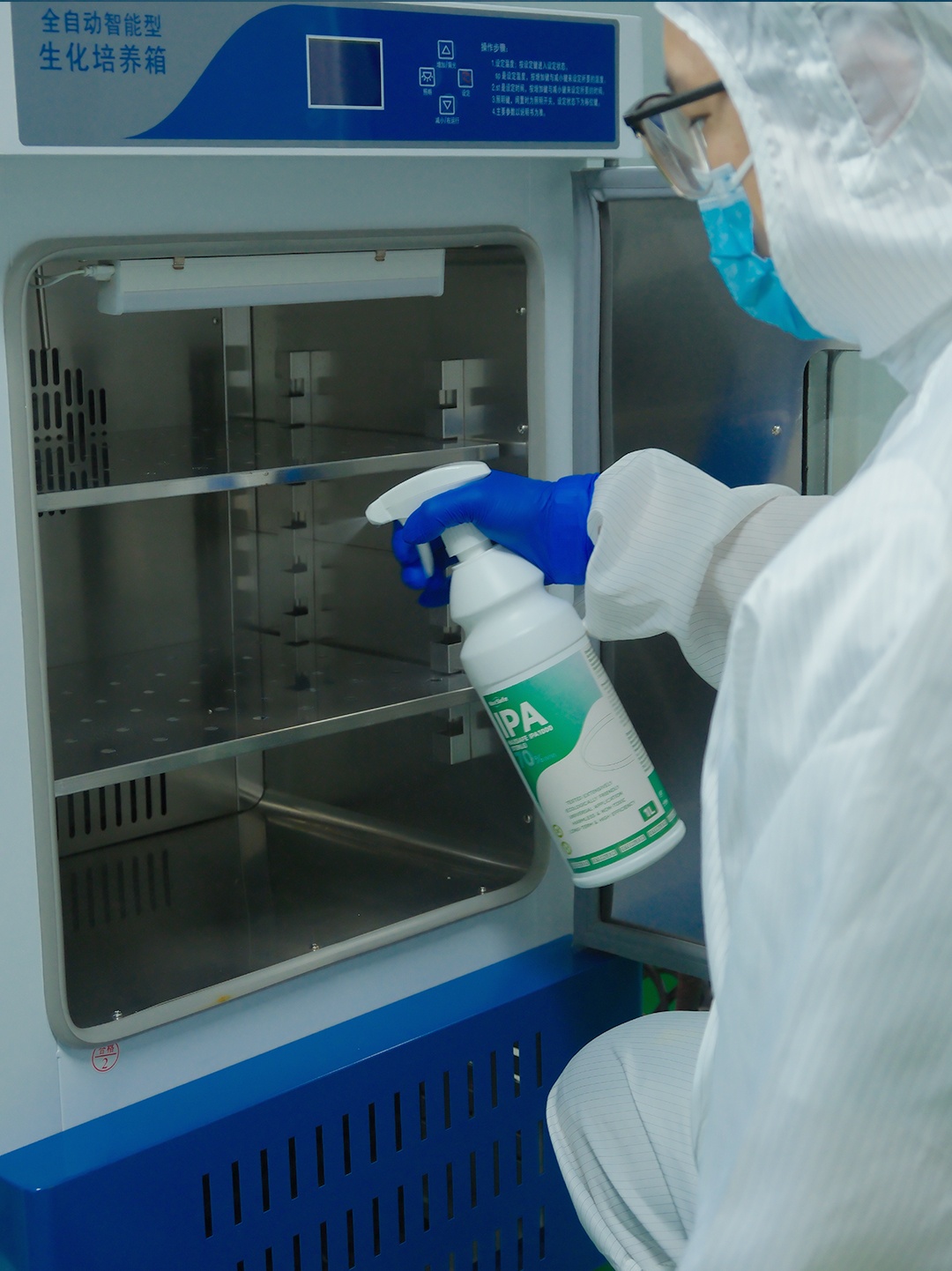
Critical Engineering of Anti-Backflow Nozzle Technology for Sterile Zones
The integrity of a sterile disinfectant is only as reliable as the delivery system used to apply it. In critical pharmaceutical environments, the risk of "back-suction"—where air from the surrounding environment is pulled back into the bottle after a spray—is a primary concern. To mitigate this, advanced spray systems now utilize anti-backflow nozzle technology. This mechanism creates a complete mechanical seal immediately after each actuation, ensuring that the remaining contents stay isolated from the external atmosphere.
This engineering detail is paramount for Grade A zones where any introduction of external particulates or microorganisms could lead to a catastrophic sterility failure. By preventing the ingress of contaminants, the system maintains the gamma-irradiated status of the fluid throughout its usage cycle. This provides operators with the confidence that the last spray of the bottle is as sterile as the first, eliminating the need for frequent, wasteful replacements of partially used containers.
Hermetic Sealing: Prevents atmospheric contamination between applications.
Sterility Assurance: Maintains the internal environment of the bottle post-opening.
Operational Safety: Reduces the risk of chemical degradation due to air exposure.

Validated Efficacy and Compliance with EU GMP Annex 1 and FDA Guidance
Regulatory compliance in sterile drug production is non-negotiable. The application of disinfectants in aseptic processing must be backed by rigorous validation data. This includes proven efficacy against a broad spectrum of challenging microorganisms. Specifically, a validated agent must demonstrate a high kill rate against Staphylococcus aureus, Escherichia coli, Pseudomonas aeruginosa, and Candida albicans to be considered suitable for high-grade aseptic environments.
Beyond biological efficacy, the documentation accompanying the product is vital for audit readiness. Every batch is typically supported by a Certificate of Analysis (COA) and a Certificate of Sterility, ensuring that the product has undergone gamma irradiation. This level of traceability is essential for facilities adhering to the EU GMP Guide (Manufacture of Sterile Medicinal Products) and FDA Guidance for Industry regarding aseptic processing, where the provenance and purity of every material entering the cleanroom must be documented.
The use of such validated systems simplifies the qualification process (IQ/OQ/PQ) for pharmaceutical companies, as the sterility of the agent is pre-verified, allowing the facility to focus on the validation of the application technique and the resulting surface bioburden levels.
Strategic Application in RABS and Product Contact Surfaces
In the hierarchy of cleanroom control, Restricted Access Barrier Systems (RABS) and product contact surfaces represent the highest risk areas. These zones require a disinfection strategy that is both highly effective and residue-conscious. The application of sterile sprays in these areas is designed to eliminate transient contamination introduced during manual interventions or equipment setup.
Effective application involves targeting not only the obvious horizontal surfaces but also the critical "touch points" and equipment interiors. Because these agents are formulated specifically for aseptic zones, they are compatible with the high-grade materials used in modern pharmaceutical machinery. The ergonomic design of the delivery bottles—ensuring they do not slip from gloved hands—reduces the likelihood of accidental drops or spills, which could otherwise introduce a source of contamination into a Grade A environment.
Furthermore, the double-wrapped individual packaging allows for a seamless transfer process. The outer wrap is removed in a lower-grade transition zone, and the inner sterile wrap is only opened once the product is inside the critical zone, maintaining a strict chain of sterility from the manufacturer to the point of use.
Comparison of Sterile Disinfection Requirements by Cleanroom Grade
| Environment Grade | Primary Contamination Risk | Disinfection Requirement | Recommended Delivery Method |
|---|---|---|---|
| Grade A (Aseptic) | Critical / Immediate | Sterile, Sporicidal, COA verified | Anti-backflow sterile spray |
| Grade B (Background) | High / Constant | Validated Efficacy, Sterile | Sterile spray or wipe |
| Grade C (Preparation) | Moderate / Managed | Broad-spectrum efficacy | Standard pharmaceutical spray |
| Grade D (Support) | Low / General | General cleaning agents | Bulk application / Mops |
| RABS / Isolators | Extreme / Zero-tolerance | Gamma Irradiated, Sterile | Precision sterile delivery |
Evaluating Supplier Capabilities for High-Grade Sterile Disinfectants
When selecting a partner for sterile disinfection solutions, pharmaceutical procurement managers must look beyond the chemical formulation. The ability of a supplier to maintain a sterile supply chain is the most critical factor. A reliable provider should offer comprehensive support, including batch-specific sterility certifications and evidence of gamma irradiation processes. This ensures that the product does not become a vector for contamination itself.
Additionally, the adaptability of the solution is key. Whether a facility requires 500 mL or 1000 mL configurations, the packaging must be designed for the rigours of cleanroom transfer. The integration of proprietary technology, such as NaxSafe's focus on VHP and eco-friendly sterilization, reflects a broader industry trend toward reducing toxic residues while increasing sporicidal efficacy. Companies that invest in patented delivery systems and modular disinfection units are better equipped to help clients meet the evolving demands of global health authorities.
Evaluating the supplier's experience with other biotech and pharma companies provides an indicator of their understanding of the "contamination control strategy" (CCS). A supplier that understands the relationship between the disinfection agent, the surface material, and the regulatory requirement is a strategic partner rather than just a vendor.
Future Trends in Aseptic Contamination Control and Sterilization
The industry is moving toward a more holistic approach to sterilization, where manual spray applications are integrated with automated systems. We are seeing an increase in the use of Vaporized Hydrogen Peroxide (VHP) for room-level decontamination, complemented by targeted sterile sprays for high-touch surfaces. This hybrid approach ensures that while the overall environment is sterile, specific critical points are maintained through frequent, validated interventions.
Moreover, there is a growing demand for "green" sterilization—solutions that provide high sporicidal kill rates without leaving harmful residues or requiring extensive aeration times. The shift toward food-grade hydrogen peroxide derivatives and eco-friendly formulations allows manufacturers to maintain safety standards while reducing their environmental footprint. As regulatory bodies like the FDA continue to tighten the requirements for aseptic processing, the reliance on pre-validated, gamma-irradiated sterile solutions will only increase.
Ultimately, the goal is the complete elimination of human-induced contamination. The evolution of ergonomic, sterile-transfer packaging and anti-backflow technology is a step toward this goal, minimizing the risks associated with manual handling in the most sensitive areas of drug production.
Common Technical Questions Regarding Sterile Disinfection
Why is anti-backflow technology necessary for cleanroom sprays?
Anti-backflow technology prevents ambient air, which may contain microbes or particles, from being sucked back into the bottle after the trigger is released. This ensures the fluid remains sterile throughout the entire usage period, which is critical for Grade A and B areas.
What certifications should I expect with every batch of sterile disinfectant?
Every batch should be accompanied by a Certificate of Analysis (COA) and a Certificate of Sterility, confirming that the product has been gamma irradiated and meets the required purity and efficacy specifications.
How does double-wrapped packaging facilitate cleanroom transfer?
Double-wrapping allows the operator to remove the outer layer in a lower-grade area and the inner layer only once the product has entered the sterile zone, preventing the transfer of external contaminants into the cleanroom.
Which microorganisms are typically used to validate sterile spray efficacy?
Validation typically focuses on common pharmaceutical contaminants including Staphylococcus aureus, Escherichia coli, Pseudomonas aeruginosa, and Candida albicans to ensure broad-spectrum efficacy.
Can these sterile sprays be used on product contact surfaces?
Yes, they are specifically formulated for use in aseptic processing areas, RABS, and product contact surfaces, provided they are compliant with your specific material compatibility and residue limits.
What is the difference between a standard disinfectant and a sterile sporicidal agent?
A standard disinfectant may reduce bioburden but isn't necessarily sterile itself. A sterile sporicidal agent is gamma irradiated to ensure it is free of contaminants and is formulated to kill highly resistant bacterial spores.
Industry Standards and Technical References
EU GMP Volume 4 - Annex 1: Manufacture of Sterile Medicinal Products
FDA Guidance for Industry: Sterile Drug Products Produced by Aseptic Processing
WHO Guidelines on Good Manufacturing Practices for Sterile Pharmaceutical Products
PubMed: Research on Sporicidal Efficacy in Pharmaceutical Cleanrooms
Ensuring the sterility of critical zones is a continuous process of validation and vigilance. By utilizing advanced delivery systems and certified sterile agents, pharmaceutical manufacturers can safeguard their products and maintain unwavering compliance with global health standards.
Related Technical Solutions